Implementing an optimized racking system is one of the most effective ways for a warehouse to increase productivity...
Blog categories
Search in blog
Blog tags
Photo gallery
No featured images
Implementing an optimized racking system is one of the most effective ways for a warehouse to increase productivity...
Introduction – The Technology That Changes the Game In recent years, the world of logistics and warehouse operations...
Importanta service-ului la stivuitoare In mediul logistic si industrial, stivuitorul reprezinta un element esential...
Buying a used forklift can be a smart decision if you follow a step-by-step guide. Used forklifts provide a...
Introduction – Why Buy a Used Forklift? Buying a used forklift can be a smart decision for businesses that want to...
No featured images
In the last decade, forklift tires have undergone significant changes. Since 2013, when Continental launched the CS20 model, we now see new compounds, optimized tread designs, digital monitoring solutions, and even sustainability trends. All these aspects directly matter to logistics managers and warehouse supervisors: lower costs, improved safety, and equipment available for longer periods of time.
In the last decade, forklift tires have gone through important transformations. Since 2013, when Continental introduced the CS20, new compounds, optimized tread designs, digital monitoring solutions, and sustainability trends have appeared. These innovations matter directly to logistics managers and warehouse supervisors: reduced costs, better safety, and improved equipment availability.
The launch of the Continental CS20 was a turning point. It was a solid superelastic tire, designed to reduce vibrations and provide greater stability in mixed applications – both indoor and outdoor. Its “closed shoulder” design and continuous tread were meant to eliminate one of the most common daily issues: excessive vibrations affecting both operator comfort and equipment lifespan.
Warehouse managers quickly noticed the benefits: fewer mast failures, more precise maneuverability in tight spaces, and reduced noise levels in production halls. It was not just a more robust tire but a step forward in fleet efficiency.
In the following years, Continental introduced the CS20+ version, equipped with the Plus Compound. This provided longer service life and increased resistance to cuts and punctures. For a logistics manager, these improvements translate directly into fewer unplanned downtimes and better predictability of maintenance costs.
Another major change was the diversification of available sizes. Initially designed for standard 1.5–3.5 ton forklifts, the CS20 range expanded to tow tractors and equipment used in logistics terminals and airports. This adaptability strengthened Continental’s position in a market where industrial tires are evaluated not only for robustness but also for their ability to support continuous and demanding operations.
Today, a manager focused on total cost of ownership doesn’t look only at the purchase price. He evaluates wear resistance, impact on energy consumption, and service intervals. From this perspective, the CS20 family remains relevant, but competition has pushed the industry toward even more specialized products, which we will discuss in the following chapters.
For modern fleets, the range of forklift tires available today includes solid tires optimized for vibration reduction as well as innovative solutions with special compounds for improved energy efficiency. The evolution of recent years clearly shows that the focus is no longer only on durability but also on operational efficiency and long-term safety.

If the first solid forklift tires were mainly designed to avoid flats and withstand heavy loads, in recent years manufacturers have gone further. The focus has shifted toward wear resistance under severe conditions, heat dissipation, and operator comfort during long shifts. For a warehouse supervisor, these improvements mean fewer interruptions and steady productivity even under extreme conditions.
One example is the Galaxy MFS 101 Severe Duty, a tire designed for highly demanding environments. Its solid construction has more rubber above the wear limit, allowing for significantly longer service life. Its tread design has been optimized for heat dissipation, an essential aspect when equipment runs on hard surfaces and warehouse temperatures rise in summer. This type of tire reduces the risk of deformation and extends the lifespan of mechanical components.
Another frequently mentioned model is the Ascenso FLS 692 Solid Tire. It is aimed at companies operating in 2–3 shifts per day, with equipment that rarely stands idle. Its improved lateral stability and deeper tread make it suitable for mixed-use warehouses, where forklifts move seamlessly between indoor and outdoor areas. Managers appreciate the reduced downtime and the safety it ensures for operators, even on wet or uneven surfaces.
Manufacturers have also developed new rubber compounds. If in the past the focus was only on abrasion resistance, now we see low rolling resistance compounds that help reduce energy consumption. On an electric forklift, the difference in autonomy is immediately noticeable, and for a fleet of dozens of machines, this means significant savings on electricity bills. These innovations are part of the operational efficiency strategy that more and more warehouse managers follow.
Additionally, the market has seen a diversification of tread designs. Closed-shoulder models reduce vibrations and noise, while deeper tread patterns provide extra traction for yards or construction sites. Choosing the right tire depends on the type of tasks and frequency of movements. A supplier with a varied portfolio can make the difference between a good purchase and a costly mistake.
For those seeking both durability and flexibility, the offer of forklift and logistics tires is a reliable solution. These products are designed to meet the requirements of indoor warehouses as well as the operational needs of outdoor environments, where soil and climate conditions test even the most robust models.
In conclusion, the new generations of industrial tires are no longer just consumables but essential components in optimizing costs and maintaining productivity. For a logistics manager, the difference between a standard tire and a new-generation model translates directly into hours gained and reduced risks.
In the past, warehouse managers relied on visual inspections or mechanics’ experience to decide when to replace forklift tires. Today, technology brings a new approach: real-time monitoring through sensors and digital platforms. This shift from reactive to predictive maintenance allows reduced downtime and precise planning of maintenance budgets.
One example is the ContiConnect platform developed by Continental. The system uses integrated tire sensors to transmit data on temperature and wear level to an app or web portal. For a warehouse manager, this means not waiting for a tire to fail; notifications are received before the defect appears, and replacements are scheduled according to the fleet’s actual condition.
Digital monitoring provides clear benefits:
This trend is not limited to logistics. In agriculture, where machines work on variable terrain, sensor monitoring helps farmers avoid soil compaction and excessive fuel consumption. That is why investing in agricultural tires with modern technologies is not just an expense but a way to protect land and crops.
Road transport also benefits from these innovations. Trucks covering long distances face rapid tire wear and temperature fluctuations. With sensors and automatic alerts, fleet managers can prevent blowouts caused by overheating. In addition, the cost per kilometer is kept under control. Here, solutions such as the truck tires range have become a necessary investment for companies relying on fast and safe transport.
For modern warehouses, digitalization also means integrating tire data into ERP or WMS systems. A logistics manager can view both stock levels and fleet condition on the same dashboard. This transparency leads to faster decisions: when to order parts, when to replace tires, and how to distribute workload across forklifts.
As these technologies become standard, industrial tires are no longer seen only as consumables but as an integrated part of the entire logistics system. For a pragmatic manager, the advantage is clear: fewer unplanned downtimes, a fleet always available, and increased long-term safety.
As pressure on costs and the environment grows, manufacturers of industrial tires are investing more in sustainable solutions. It is no longer just about making more durable tires but about making them cleaner, more economical, and easier to manage throughout their lifecycle. For warehouse managers, these trends bring both operational advantages and image benefits in front of partners or environmental auditors.
The first step is the use of recycled materials in production. Manufacturers like Continental and Trelleborg are already testing compounds made from recycled rubber and additives that reduce carbon footprint. The result: durable tires with less environmental impact. At the same time, energy efficiency remains a priority – low rolling resistance compounds reduce diesel, LPG, or electricity consumption, which directly matters for large fleets.
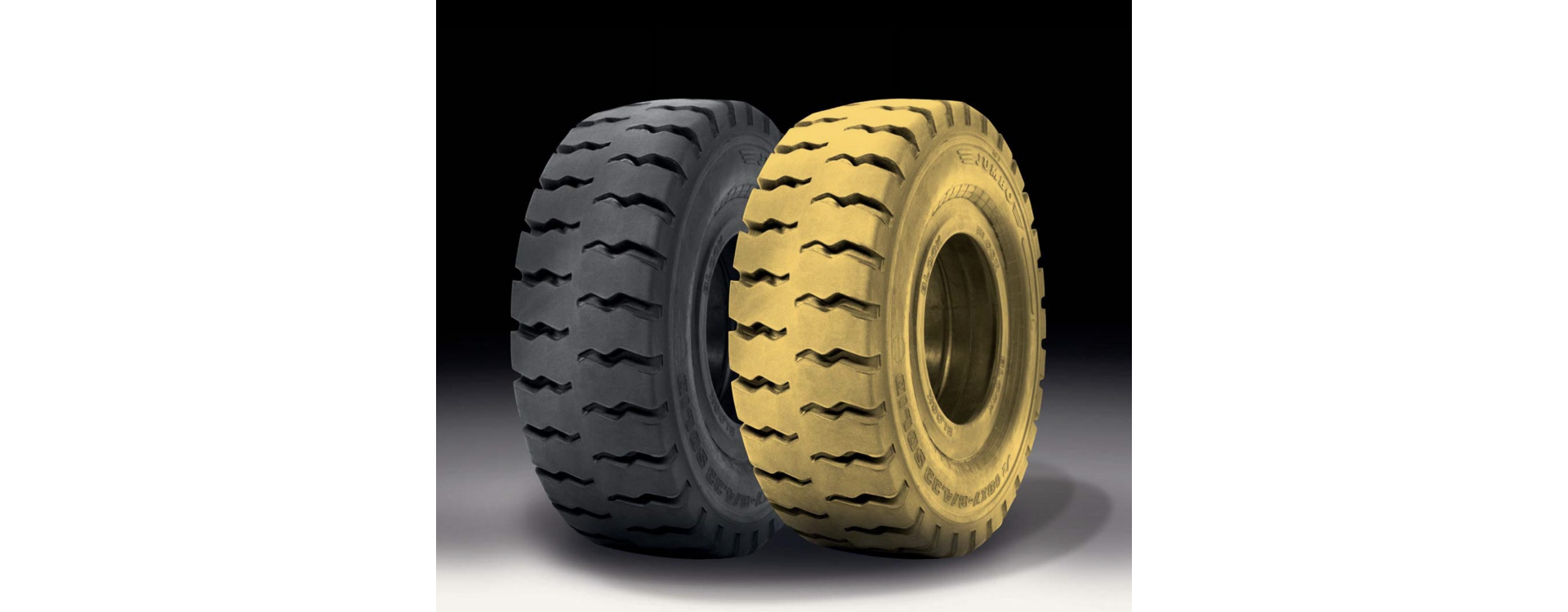
Another important direction is represented by non-marking tires, used in food, pharmaceutical, or clean warehouses where floors must remain spotless. These do not leave black marks and are made from special compounds that maintain grip without compromising hygiene. For a warehouse supervisor managing HACCP or ISO certified facilities, such solutions can even be mandatory.
At the same time, we see increased use of solid tires instead of pneumatic ones. The advantage is clear: no flats, less maintenance, and better resistance to punctures. For equipment working in two or three daily shifts, these benefits mean higher availability and almost no downtime. A concrete example is the Focus Elastomeric 15x4.5-8 rim with solid tire, which combines the durability of a superelastic tire with easy mounting and the reliability of a premium product.
Looking ahead, digitalization and sustainability will go hand in hand. Beyond sensors and monitoring platforms, there is talk of tires capable of providing data about each trip’s carbon footprint or even integrated recycling after end-of-life. For fleet managers, these innovations will bring not only safety but also a clear reporting tool for performance and sustainability indicators.
Thus, forklift tires become part of a broader strategy: reducing costs, increasing efficiency, and complying with modern environmental standards. They are no longer just consumables but critical elements in a logistics chain that must be fast, safe, and responsible.
Choosing and properly maintaining tires is no longer just about wear resistance but involves digital technologies, special compounds, and sustainable solutions. For a warehouse manager, these changes translate directly into more uptime, controlled operating costs, and increased operator safety. From the first CS20 models to the latest solid tires with integrated sensors, evolution has brought concrete benefits for modern logistics. UTEC provides a wide range of available models for forklifts, agricultural machinery, or trucks, ensuring every fleet operates at maximum capacity with reduced risks and improved efficiency.
Star of the Week 02 2024 - Electric forklift LINDE E-16-02 (386)
JUNGHEINRICH BRAND HISTORY: A Remarkable Evolution in the World of Material Handling Equipment
most common problems with electric forklifts in winter
STAR OF THE WEEK 04 2024 - TOYOTA LPG FORKLIFT 02-8-FGL-25
Exploring the Depths of Evolution: History, Technologies, and the Advantages of the YALE Brand in Logistics Equipment.
check_circle
check_circle
Top authors